The One-Way Street:
The One-Way Street: How the Law Demands Your Vigilance but Denies Your Protection
There is a profound contradiction at the heart of American public safety.
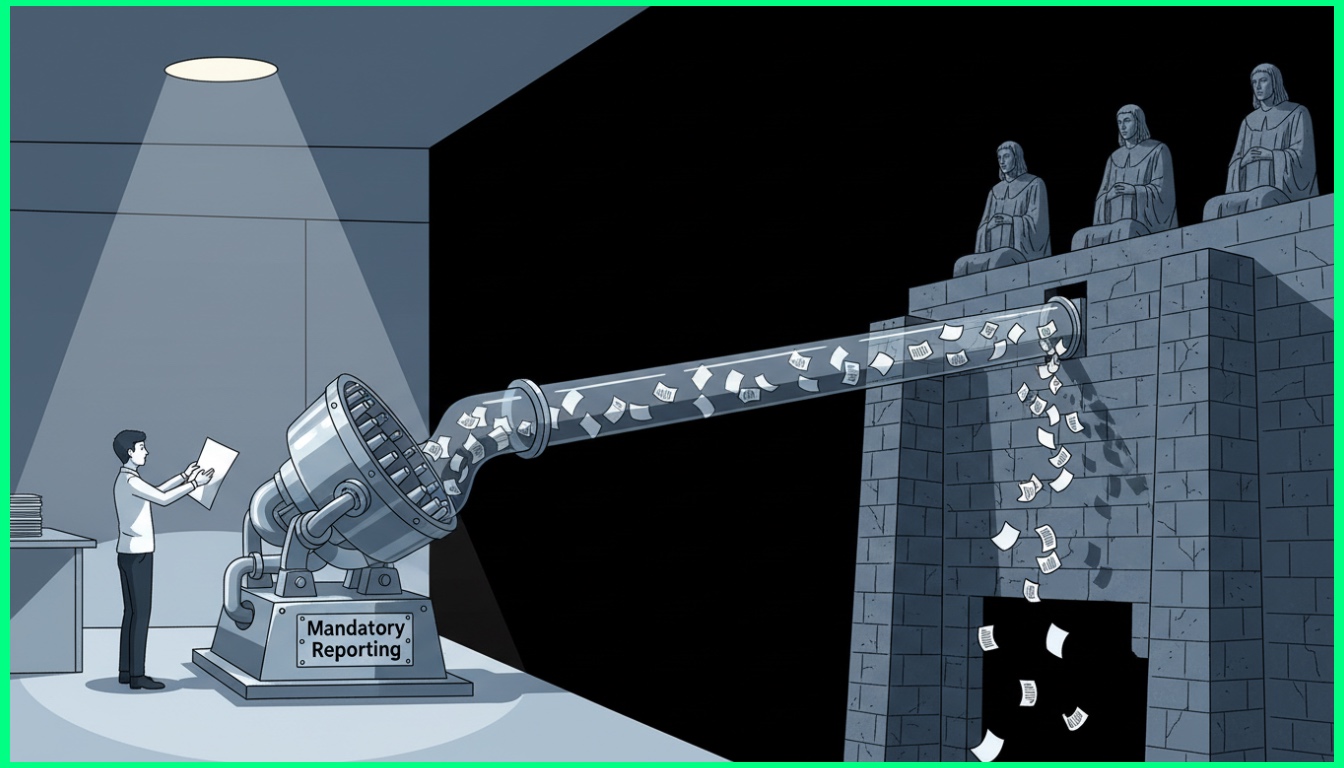
If a teacher notices a bruise on a student’s arm and fails to report it to the authorities, she can be arrested.
If a nurse suspects domestic abuse and stays silent, he faces criminal charges. This is the law of Mandatory Reporting: a rigid, unforgiving statute that places the burden of vigilance squarely on the shoulders of private citizens.
The State demands that we see, that we speak, and that we feed the system information under threat of prosecution.
But what happens once that report is filed? What is the legal obligation of the State to act on the information it demanded?
The answer, established by the highest courts in the land, is shocking in its asymmetry: Zero.
While the citizen is legally compelled to cry for help, the State is constitutionally free to ignore the call. By analyzing the "First Principles" of the American legal system—specifically Sovereign Immunity and Supreme Court rulings—we reveal a system that aggressively collects data on danger but assumes no liability for preventing tragedy.
1. The Ancient Root: "The King Can Do No Wrong"
To understand this modern contradiction, we must look to the archaic foundation of our laws. The concept of Sovereign Immunity—derived from the English maxim rex non potest peccare ("the King can do no wrong")—establishes that the government cannot be sued without its consent.
When the Founders built the American legal framework, they retained this immunity to protect the public treasury. They reasoned that if the police or social services could be sued for every crime they failed to prevent, the government would be paralyzed by litigation.
However, modern legislatures added a twist. They created statutory laws that criminalize the inaction of citizens. They effectively said, "The King can do no wrong, but you can." This set the stage for a relationship where the State holds all the authority to demand information, but none of the liability for how it is used.
2. The Paradox: Mandatory Reporting vs. Discretionary Action
The most dangerous aspect of this system is the false sense of security it generates.
Mandatory Reporting laws are designed to make the public believe that the system is watching. When we see campaigns saying "If You See Something, Say Something," we instinctively believe that "saying something" triggers a mechanism of protection.
Legally, it does not. It only triggers a mechanism of record-keeping.
Consider the mechanics of the law. A "Mandatory Reporter" acts under the weight of Statutory Obligation. If they fail to dial the hotline, they have broken the law. But the agency receiving that call—Child Protective Services (CPS) or the Police—operates under Discretionary Authority.
Courts have consistently ruled that government agencies must have "discretion" to manage their limited resources. They cannot be legally compelled to investigate every tip, even if the tip turns out to be a matter of life and death.
This creates a terrifying gap. The citizen transfers the burden of knowledge to the State. Once the teacher makes the call, she feels a sense of relief—she has "done her duty." She assumes the experts have taken over. But because the State has no duty to act, the child often falls into a void.
3. The Proof of Betrayal: DeShaney v. Winnebago County
There is no starker example of this betrayal than DeShaney v. Winnebago County (1989). This case proves that even when the mandatory reporting system works perfectly, the protection system can legally fail completely.
Four-year-old Joshua DeShaney was the victim of brutal, chronic abuse by his father. The "system" ostensibly worked as designed: Mandatory Reporters did their job. Emergency room personnel notified the Department of Social Services (DSS) of suspicious injuries. Caseworkers recorded these reports. They opened files. The State had all the data it demanded.
Yet, they did nothing to remove Joshua. Eventually, Joshua’s father beat him into a permanent vegetative state.
When Joshua’s mother sued, arguing that the State had a duty to intervene because they knew of the danger, the Supreme Court ruled against her. They established the "Negative Charter" doctrine: The Constitution prevents the State from harming you, but it does not require the State to protect you from others.
The Court essentially ruled that knowledge does not equal duty. The State can demand to know every detail of a child’s misery, but possessing that knowledge does not legally bind them to stop it.
4. The Illusion of Orders: Castle Rock v. Gonzales
If DeShaney showed that reports don't trigger action, Castle Rock v. Gonzales (2005) showed that even court orders are merely "suggestions."
Jessica Gonzales did everything the system asked of her. She obtained a restraining order. When her husband violated it and abducted her three daughters, she called the police four times. She went to the station. She cited the law.
The police did nothing. They told her to wait. Her daughters were murdered that night.
The Supreme Court ruled that despite the mandatory language on the paper ("You Shall Arrest"), police enforcement is always discretionary. They found that a restraining order does not give a citizen a "property interest" in having the police enforce it. The State sells the vulnerable a product—a "Restraining Order"—but when the time comes to redeem it, the courts declare it has no cash value.
5. Conclusion: The Reality of Self-Reliance
How do they get away with it?
They get away with it because the law was written by the State, for the State. Mandatory Reporting laws were never intended to guarantee safety; they were intended to absolve liability. By forcing citizens to report, the State shifts the blame for ignorance onto the public ("You didn't tell us!"), while the DeShaney ruling absolves the State for inaction ("We knew, but we didn't have to act.").
For the strategic thinker, this is the ultimate validation of a First Principles approach to life. The system is reactive, discretionary, and immune.
The safety of your family cannot be delegated to a phone call or a file number. The law demands you speak, but it does not promise to listen. In a world where the State has "No Duty to Protect," the only entity with a mandatory duty to ensure your survival is you.


Comments
Post a Comment